# Dialogflow: Events
Use events to trigger Dialogflow intents.
Aside from user input, events are also used to trigger intents. Any intents with the event name listed under the “Events” section will be triggered when an event occurs.
A good example of this is the default `WELCOME` event, which is already built into Dialogflow. This event is triggered whenever a new user begins chatting with the bot.
### Parametric URLs
Any intents with the events for `REF_[PARAM]` or `REF_START_[PARAM]` are triggered when the user arrives from a parametric URL.
**Example:** m.me/respondio?ref=\[PARAM].
If you would like a custom parameter to trigger a Dialogflow intent, please ensure the parameter has a prefix of `REF_` on the intent's event configuration. Example: `REF_PARAM`
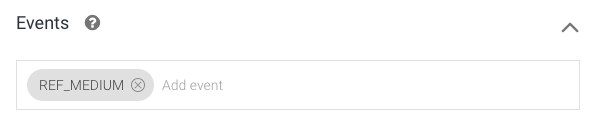
Referring to the example above, if you want to trigger an intent from m.me/respondio?ref=medium , add `REF_MEDIUM` to the intent's event configuration.
{% hint style="info" %}
Bear in mind that the `REF` prefix is not necessary for the `WELCOME` event as this event is a default event built into Dialogflow.
{% endhint %}
---
# Agent Instructions: Querying This Documentation
If you need additional information that is not directly available in this page, you can query the documentation dynamically by asking a question.
Perform an HTTP GET request on the current page URL with the `ask` query parameter:
```
GET https://docs.is-messenger.com/ismessenger/workspace-setting/integrations/dialogflow/dialogflow-events.md?ask=
```
The question should be specific, self-contained, and written in natural language.
The response will contain a direct answer to the question and relevant excerpts and sources from the documentation.
Use this mechanism when the answer is not explicitly present in the current page, you need clarification or additional context, or you want to retrieve related documentation sections.