# Contacts Overview
### Getting Here
{% hint style="warning" %}
This module is accessible by **Owners** and **Managers** only!
{% endhint %}
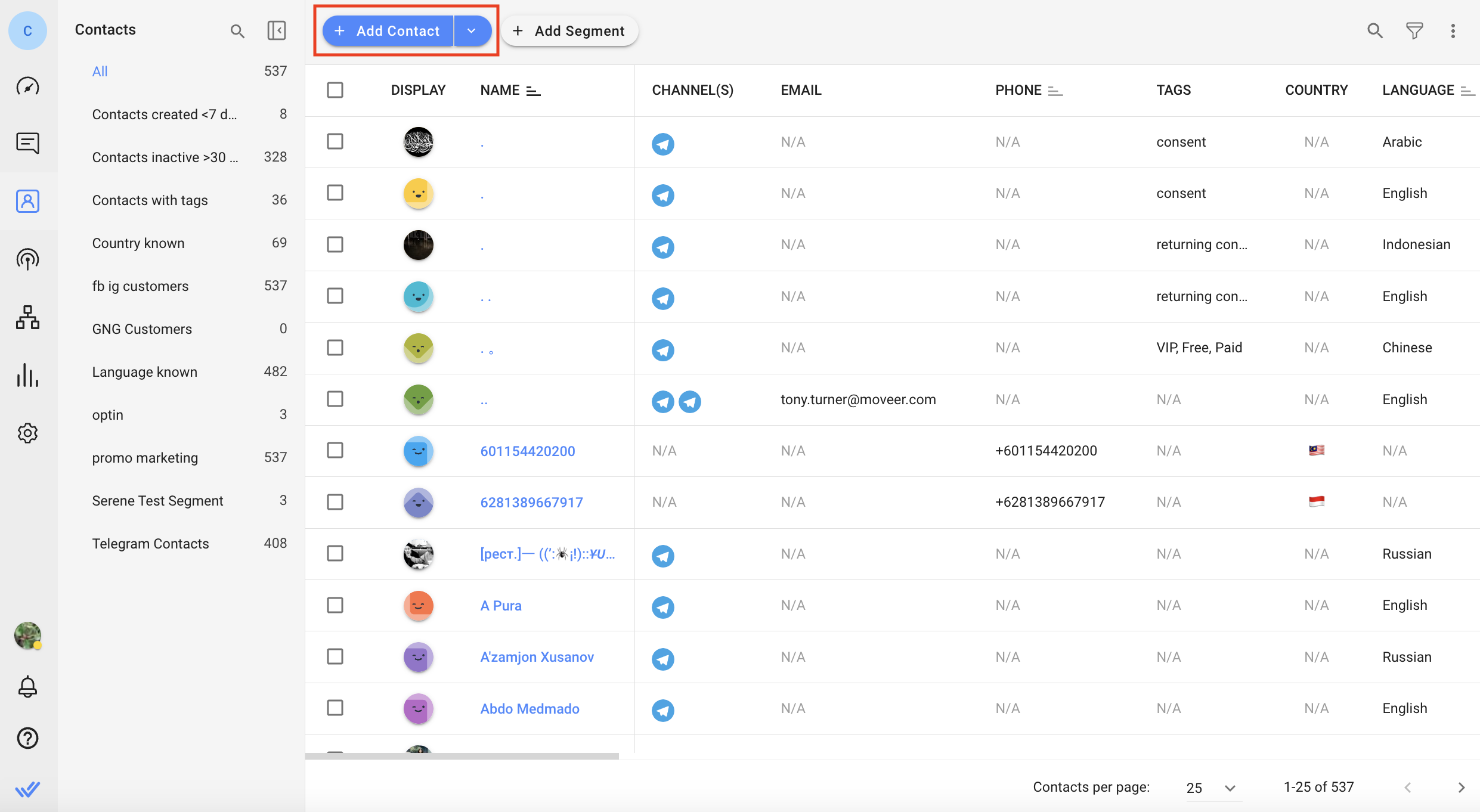
To access this module, in the side navigation menu > click **Contacts**.
### Navigation
The Contacts Module has 3 main components:
* [Segments](#segments)
* [Contacts Table](#contacts_table)
* [Contacts Menu](#contacts_menu)
### Segments
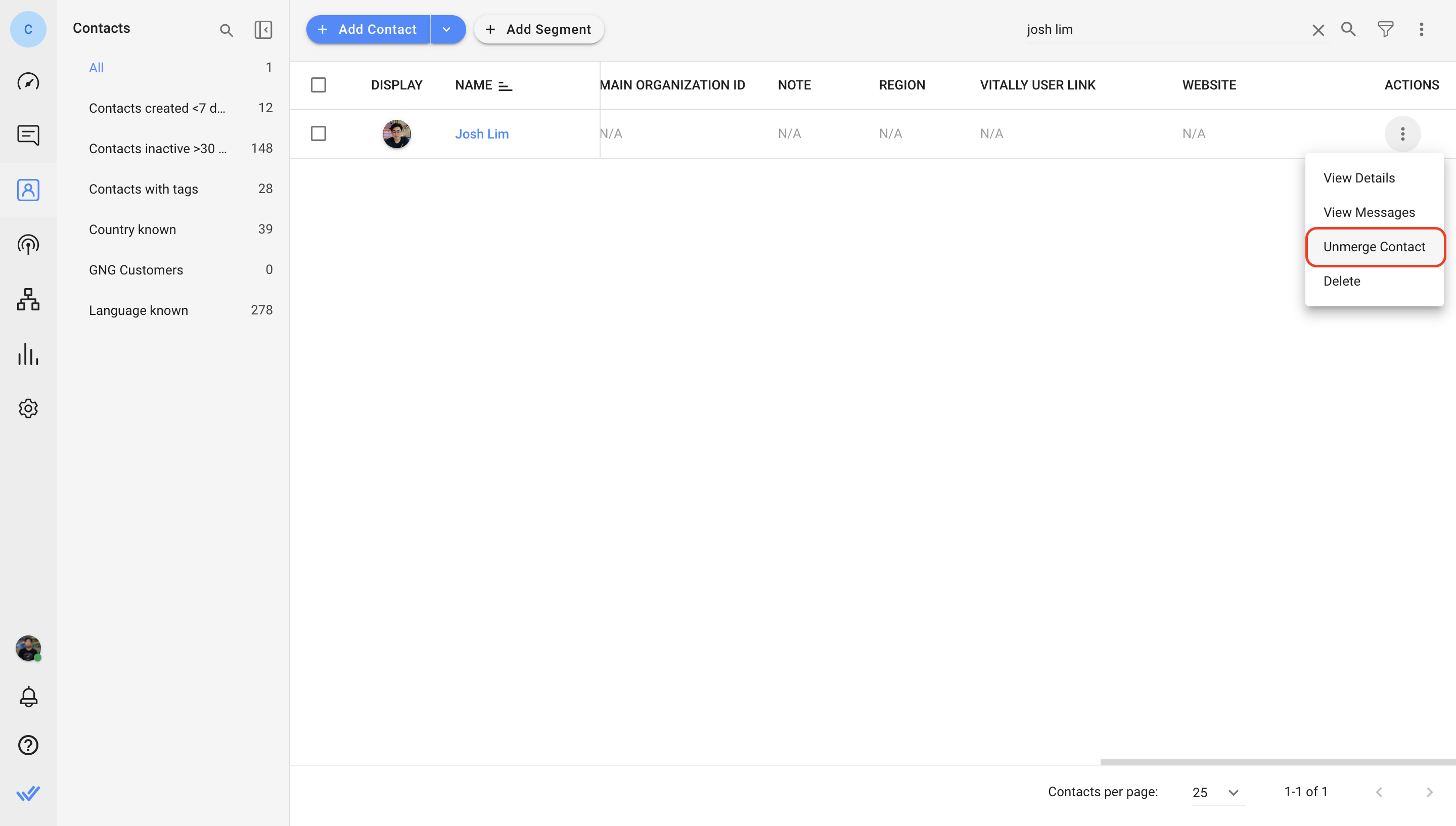
Segments are located on the left side of the **Contacts** module. Use Segments to group Contacts based on specific criteria and filters.
{% hint style="info" %}
Learn more about [Segments here](#segments)
{% endhint %}
### Contacts Table
You can find your Contacts’ records and information in the Contacts Table.
The column headers with a sorting icon are the columns that are sortable, you may sort the records of these columns by clicking on the column headers. Note that the information shown in your Contacts Table depends on the columns you have [selected to display](/ismessenger/modules/contacts.md).
### **Contact Profile**
Access a Contact’s profile by clicking on their name. A profile consists of a profile image and name, supplied by the messaging channel the Contact used to message the platform. In the absence of a profile image, an avatar will be provided. In the absence of a profile name, the phone number or email address will be used instead.
### **Actions**
In the last column of the Contacts Table is an action menu. Click on it to view the available options:
* **View Details:** Opens the Contact's record to show more details.
* **View Messages:** Show a Contact's message history in the [Messages Module](/ismessenger/modules/inbox/messages.md).
* **Delete Contact:** Deletes the Contact from the Contact List.
{% hint style="warning" %}
Be mindful when you delete a Contact as this will delete the conversation history associated with the Contact and the action cannot be undone.
{% endhint %}
### Contacts Menu
The Contacts Menu is located on the top of the **Contacts** Module. It consists of the **Add Contact** button, **Add Segment** button, Search bar, **Filter** button, and Actions menu.
### **Adding Contacts**
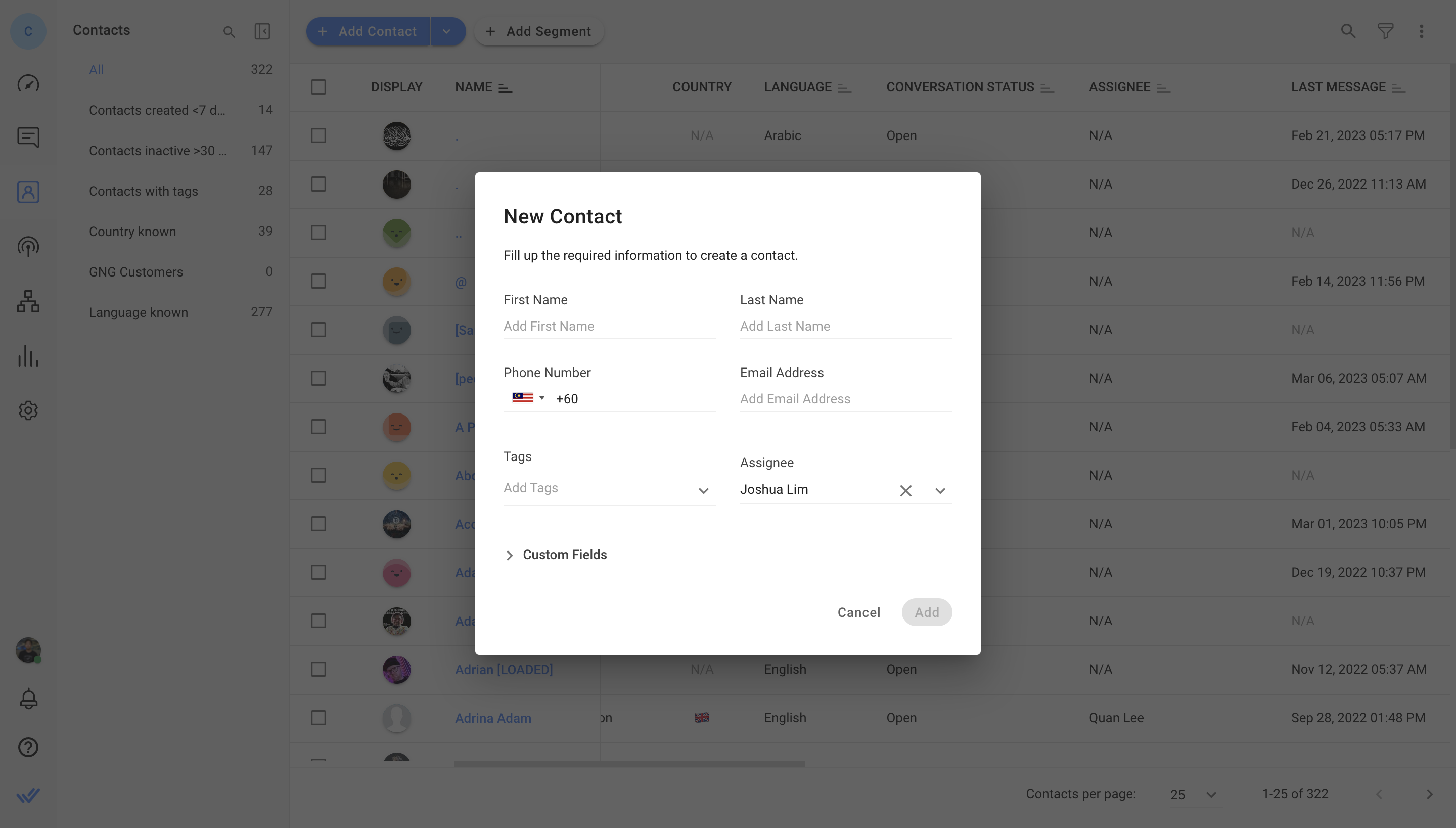
**Step 1:** In the **Contacts** Module, click the **+ Add Contact** button.
{% hint style="info" %}
You can also choose to import multiple Contacts. Learn more about [importing Contacts here](/ismessenger/modules/contacts/contact-import-1.md).
{% endhint %}
**Step 2:** Fill in the Contact's information in the form provided.
{% hint style="info" %}
Learn more about [adding WhatsApp Contacts here](https://faq.whatsapp.com/general/contacts/how-to-add-an-international-phone-number?lang=en).
{% endhint %}
**Step 3:** Review the information and click **Add**.
{% hint style="warning" %}
Automation and automatic Contact assignments will not be applied to Contacts added from the Contacts Module.
{% endhint %}
### **Searching for Contacts**
If you wish to search for a particular Contact, input your query in the search box.
{% hint style="info" %}
Learn more about [Search Behavior here](/ismessenger/modules/inbox/messages.md).
{% endhint %}
### **Filtering Contacts**
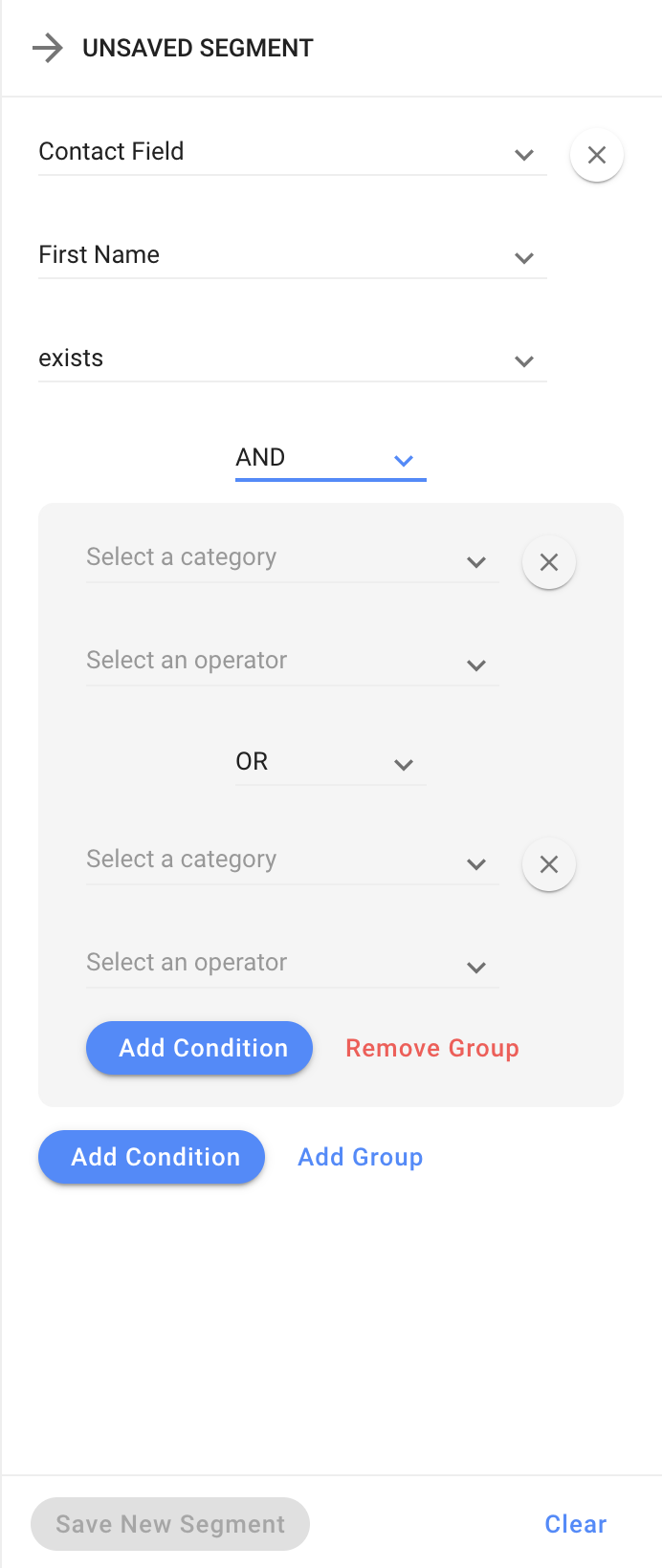
You can view a list of Contacts that fulfill a set of criteria by applying filters.
**Step 1:** Click the filter icon to open the filter drawer on the right.
**Step 2:** Configure the filters.
The following are criteria that can be filtered:
* Contact Fields
* [Standard Contact fields](/ismessenger/workspace-setting/contact-fields.md) (e.g. First Name, Country)
* Assignee
* Conversation Status
* Conversation Opened Time
* Contact Creation Time (Created At)
* Last Interaction Time
* Contact fields manually created in the Workspace (Custom Fields)
* Channels
* Contact Tag
* Last Interacted Channel
* Time Since Last Incoming Message
{% hint style="info" %}
Nested conditions are now supported. These are a group of conditions that are included in the definition of a primary condition.
{% endhint %}
**Step 3:** View the filtered results, which are updated in real-time and immediately reflected in the Contacts Table.
{% hint style="info" %}
To view all of your Contacts without any filters applied, click on the Clear button located at the bottom right of the filter drawer.
{% endhint %}
**Step 4:** Click on the **Save New Segment** button to save your Segment.
{% hint style="info" %}
Learn more about [Segments here](#segments).
{% endhint %}
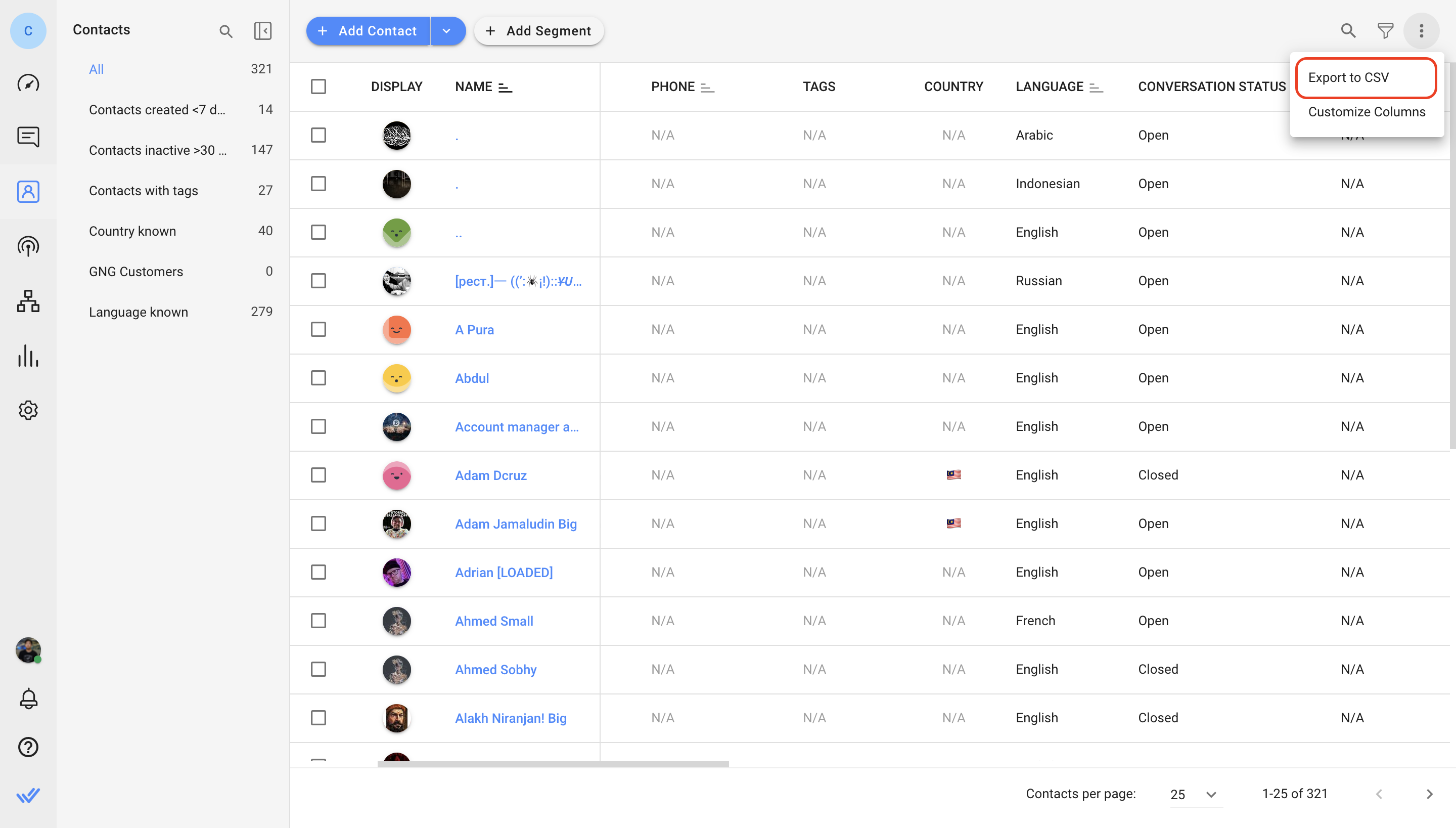
### **Exporting Contacts**
{% hint style="warning" %}
Only **Owners** and **Managers** with no such restrictions can perform this action.
{% endhint %}
{% hint style="success" %}
You can only export 100 Contacts per page from the Contacts Module.
{% endhint %}
### **Customizing Columns**
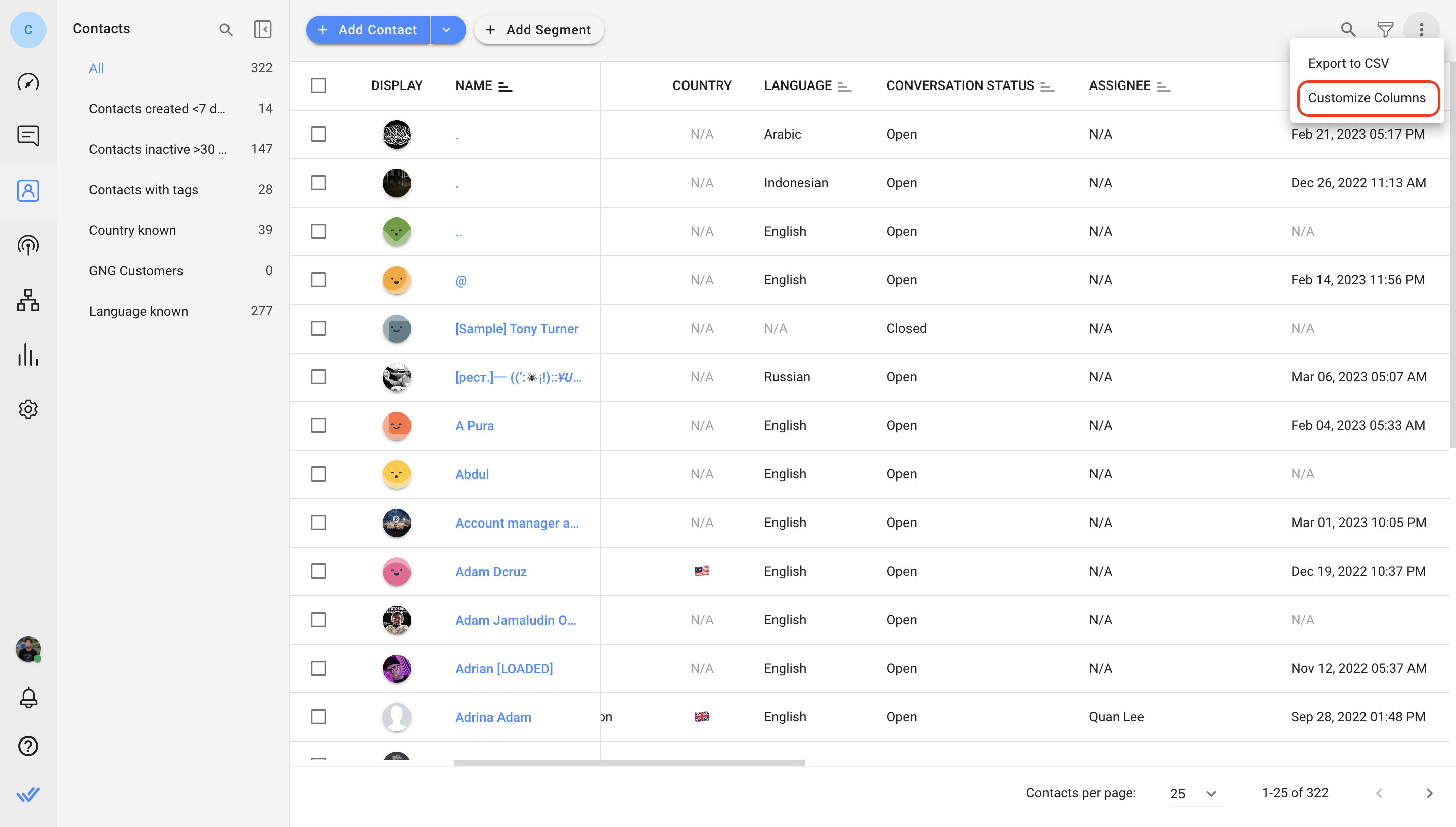
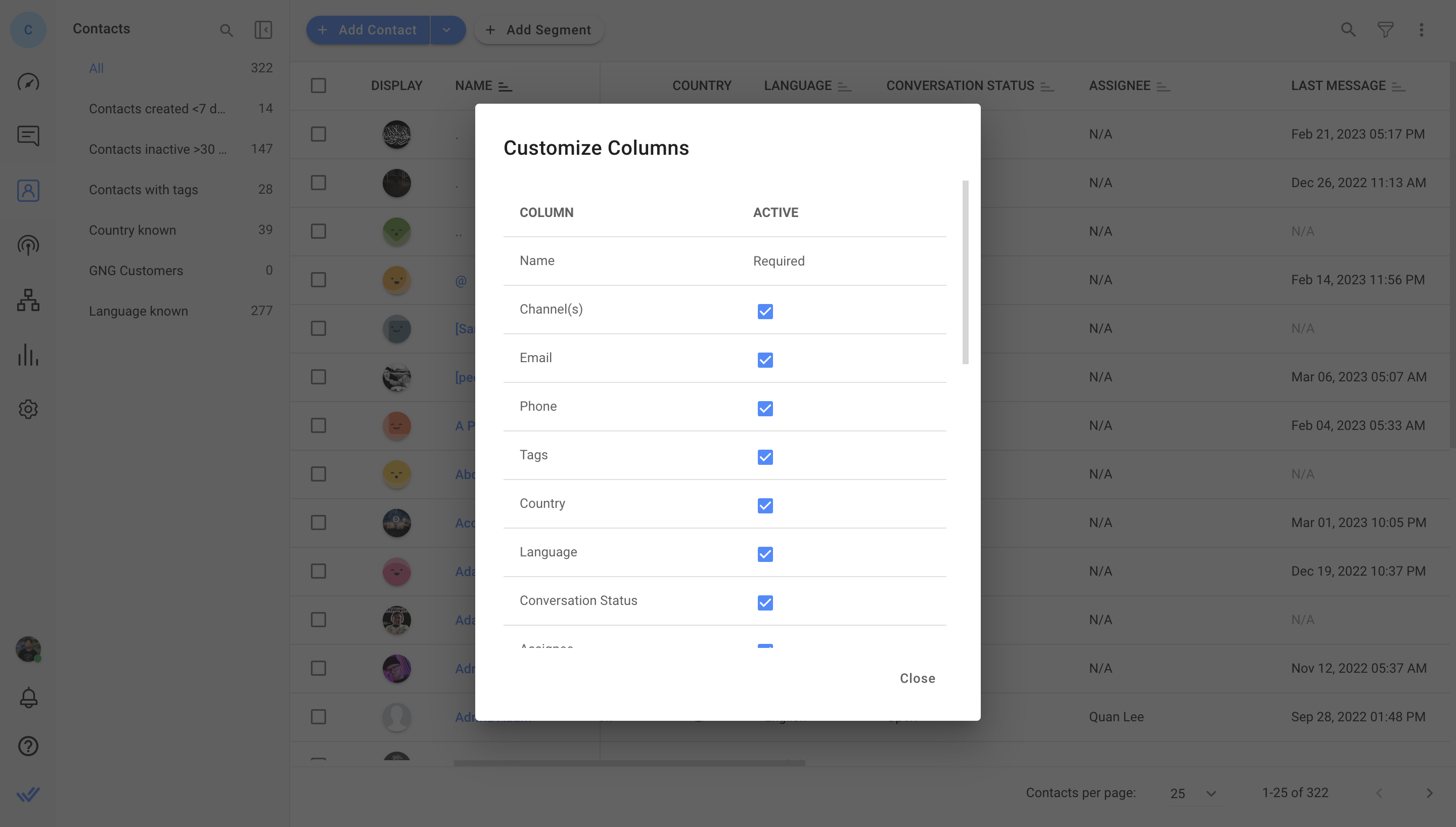
The columns shown in the Contacts Table can be customized depending on your needs. Select **Customize Columns** from the Actions menu to do this.
Select the check boxes to indicate the columns you wish to display in your Contacts Table.
The column display will automatically update and reflect your selections.
{% hint style="warning" %}
The **Name** column is required and cannot be deselected.
{% endhint %}
### Selecting Multiple Contacts
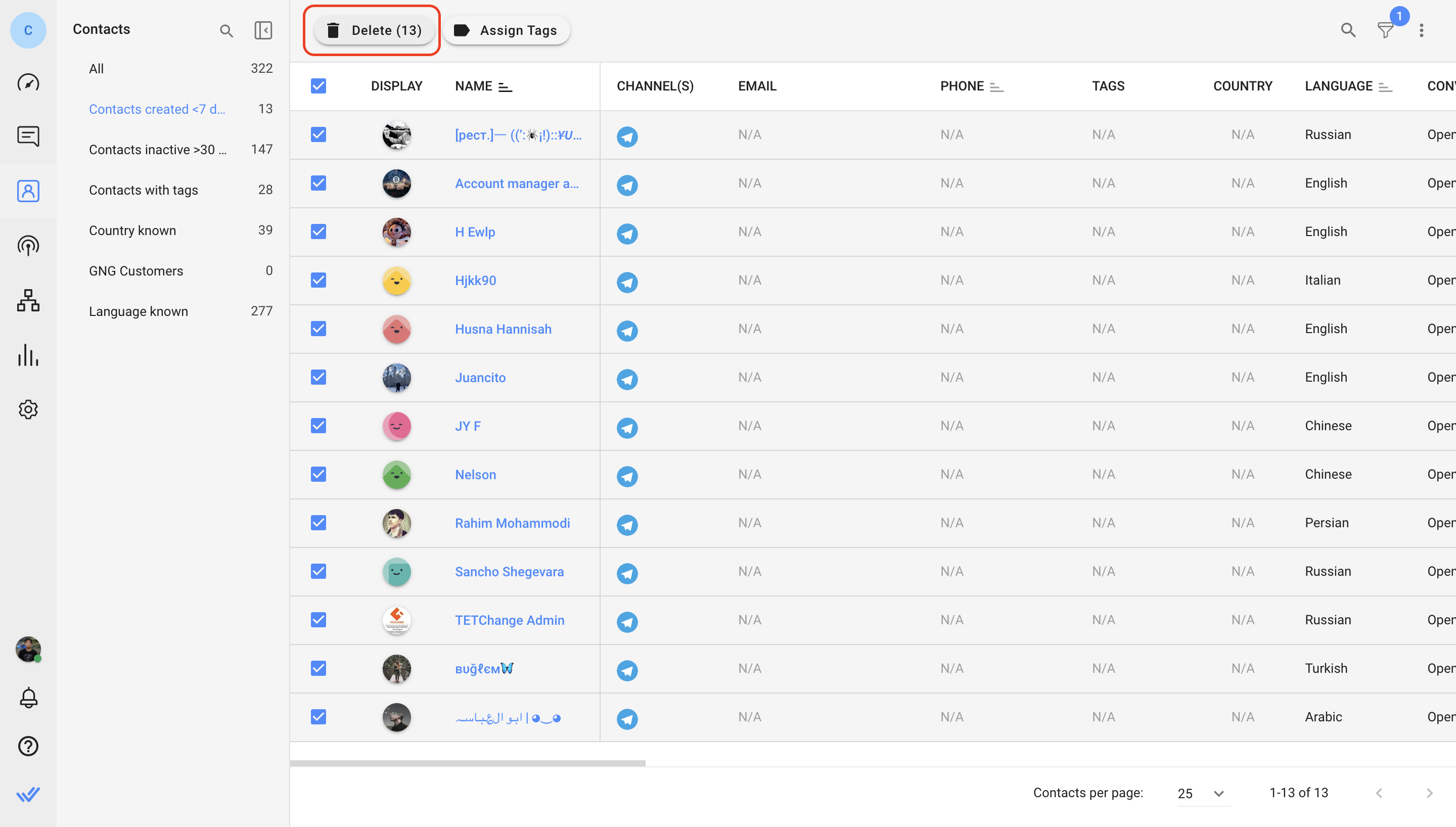
To select Contacts, check the box to the left of their respective names in the Contact row. Alternatively, select all Contacts after applying the desired filters. Once selected, you can then perform the following actions.
### **Delete Multiple Contacts**
{% hint style="warning" %}
\- Only **Owners** and **Managers** with no such restrictions can perform this action.\
\- You can only delete 500 Contacts at a time.\
\- Deleting a Contact will also delete the conversation history associated with the Contact.
{% endhint %}
**Step 1:** Select the Contacts you want to delete > Click the **Delete** button.
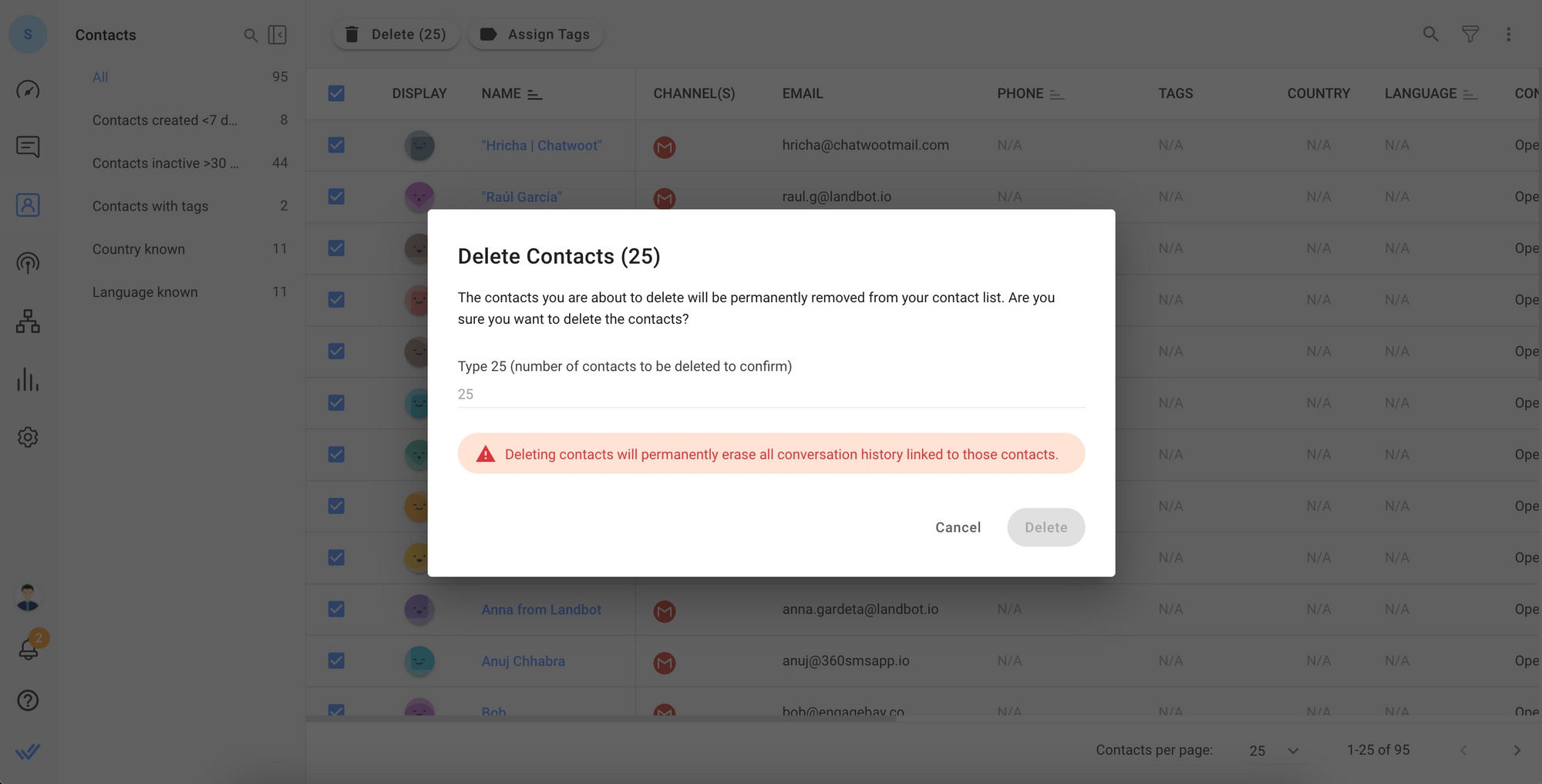
**Step 2:** On the pop-up, enter the number of selected Contacts and click **Delete** to confirm the deletion of selected Contacts.
### **Assign Tags to Multiple Contacts**
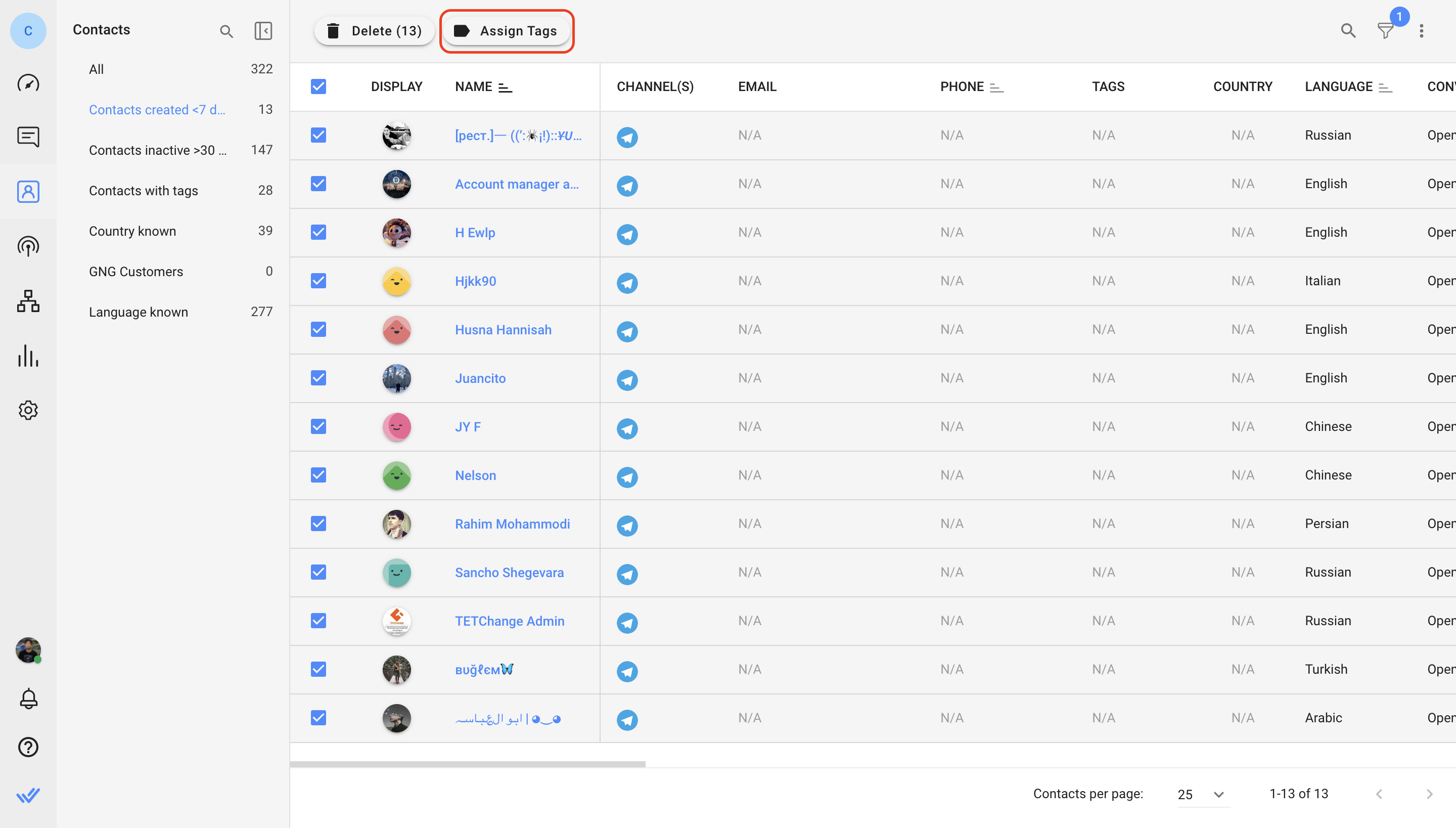
**Step 1:** Select the Contacts you want to tag.
**Step 2:** Click the **Assign Tags** button.
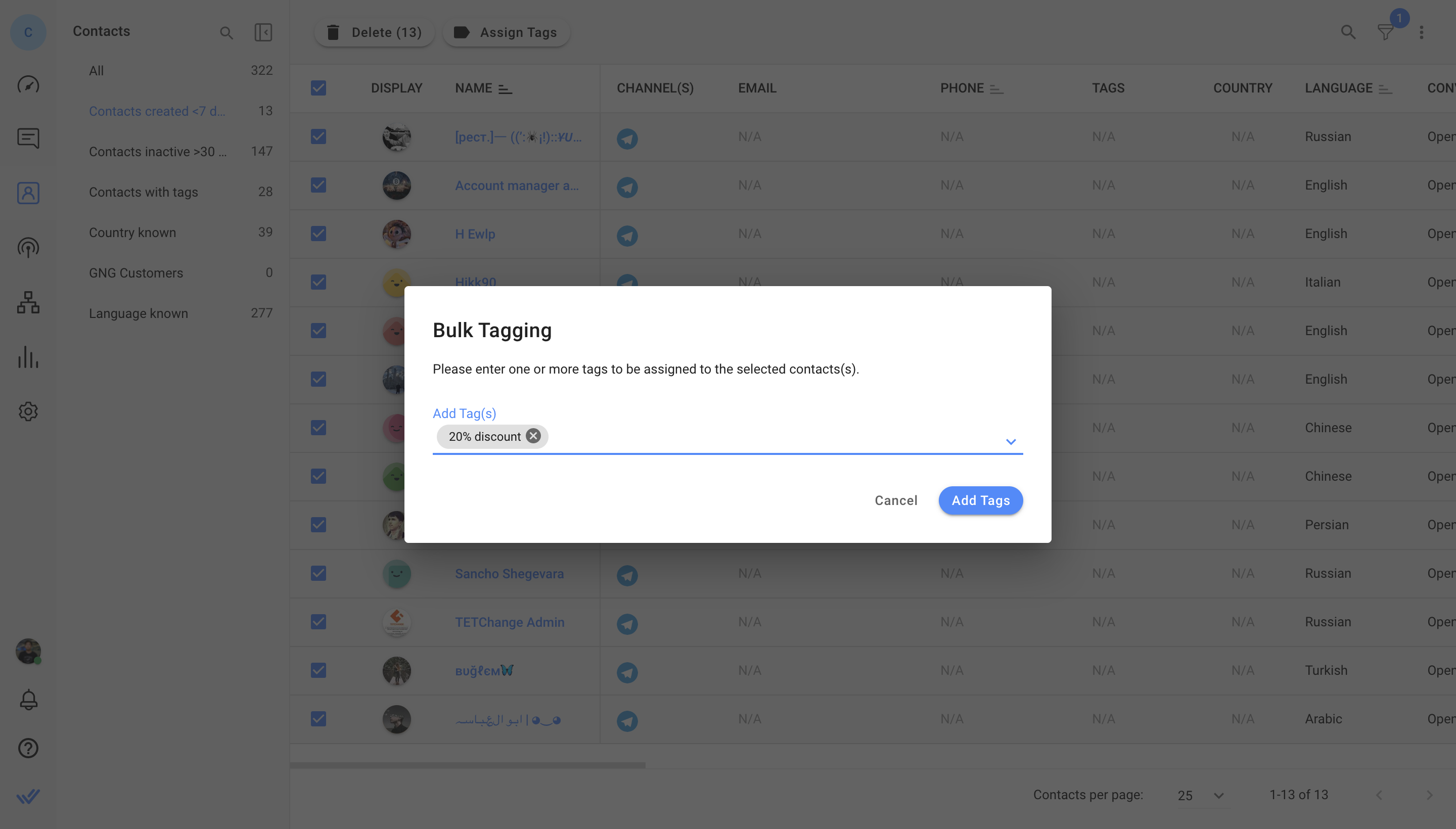
**Step 3:** Input your desired tags and click **Add Tags** to assign the tags to the selected Contacts.
{% hint style="warning" %}
You can only assign Tags to 500 Contacts at a time.
{% endhint %}
### Merge Contacts
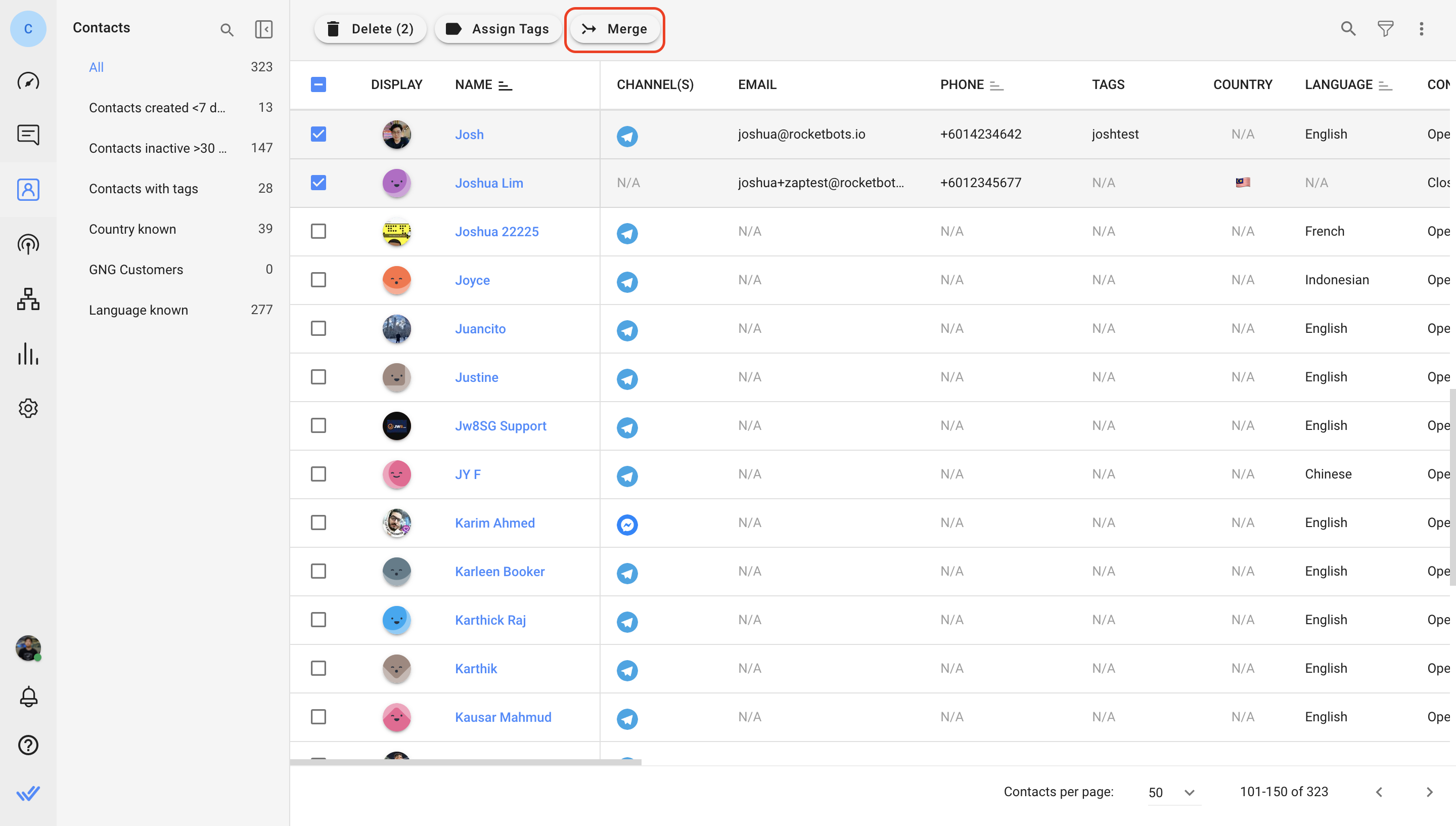
**Step 1:** Select two Contact profiles you want to merge > click the **Merge** button
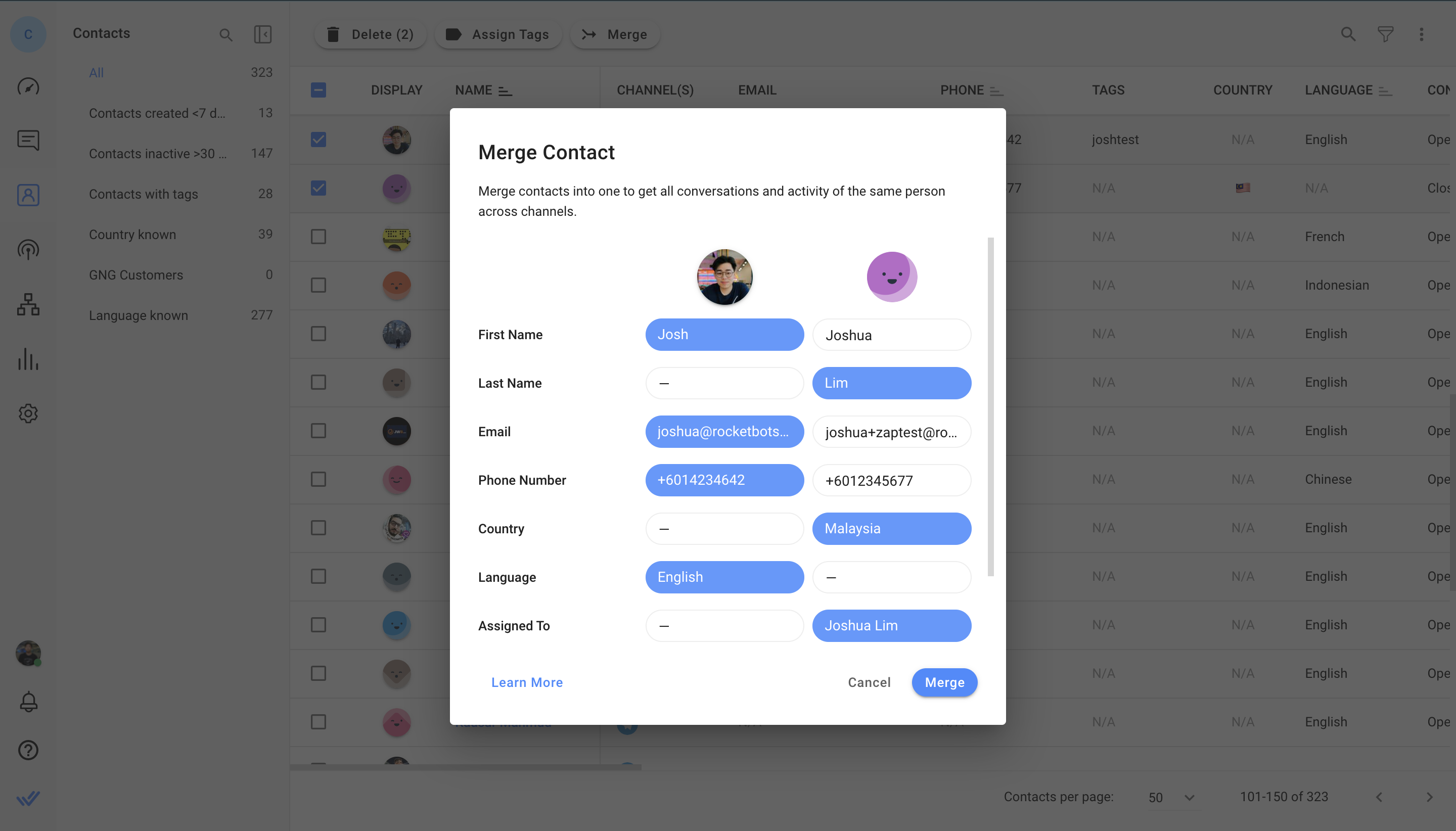
**Step 2:** Compare and review the Contact profiles and select the appropriate values to retain for the merged Contact. Then, click the **Merge** button to merge both profiles.
{% hint style="info" %}
Merging two Contacts consolidates all associated Channels, Messages, Events, and Comments into the merged profile. This provides a holistic view of the Contact and their interactions with the platform.
{% endhint %}
{% hint style="warning" %}
Conversations closed by merging Contacts will NOT trigger a Workflow.
{% endhint %}
{% hint style="warning" %}
If you experience delays in merging Contacts, it may be due to system caching. If an error occurs, please retry after 10-15 minutes.
{% endhint %}
### Unmerge Contacts
If you accidentally merge two Contacts, you can unmerge them.
**Step 1:** Search for the merged Contact profile that you wish to unmerge.
**Step 2:** At the end of the Contact row, click the Actions menu and select **Unmerge Contact.**
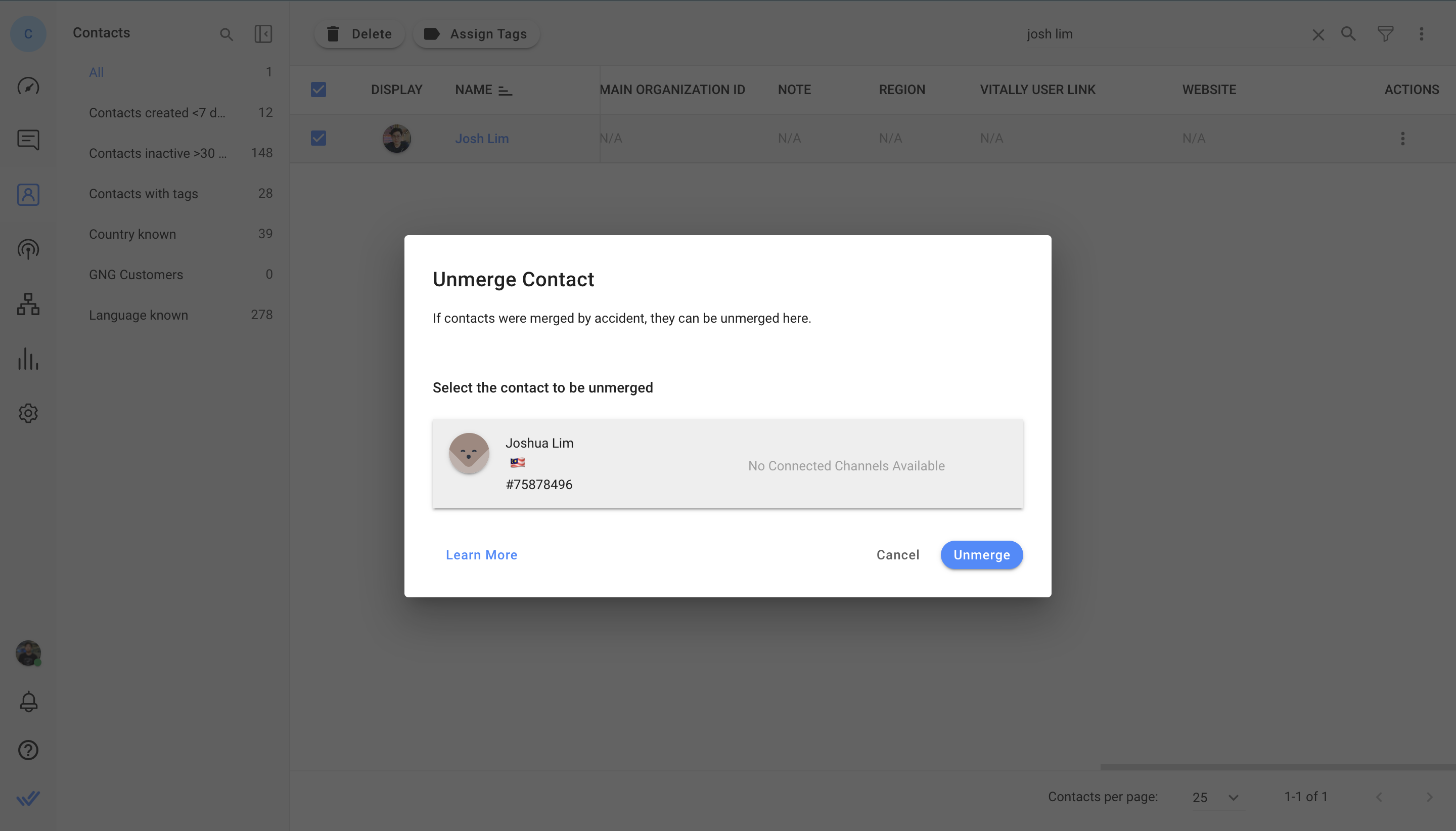
**Step 3:** Select the Contact you wish to unmerge and click the **Unmerge** button.
{% hint style="info" %}
When you unmerge a Contact, all interactions that happened after the Contacts were merged will be associated with the primary Contact only. The secondary Contact will keep any interactions made before the merge happened.
{% endhint %}
{% hint style="warning" %}
If you experience delays in unmerging Contacts, it may be due to system caching. If an error occurs, please retry after 10-15 minutes.
{% endhint %}
### FAQ and Troubleshooting
**How can I export more than 2500 Contacts?**
The Contacts Module can load Contacts up to 2500 rows of pagination, this limit allows the platform to perform searches faster and more consistently.
To export more than 2500 contacts from the Contacts Module, you can use filters to narrow your search to return a specific list of Contacts that is within the 2500 pagination range.
Another way is to upgrade to an Enterprise plan which will allow you to use the Data Export Contacts feature. Learn more about [Data Export here](/ismessenger/workspace-setting/managing-a-workspace.md).
---
# Agent Instructions: Querying This Documentation
If you need additional information that is not directly available in this page, you can query the documentation dynamically by asking a question.
Perform an HTTP GET request on the current page URL with the `ask` query parameter:
```
GET https://docs.is-messenger.com/ismessenger/modules/contacts/contacts-overview.md?ask=
```
The question should be specific, self-contained, and written in natural language.
The response will contain a direct answer to the question and relevant excerpts and sources from the documentation.
Use this mechanism when the answer is not explicitly present in the current page, you need clarification or additional context, or you want to retrieve related documentation sections.